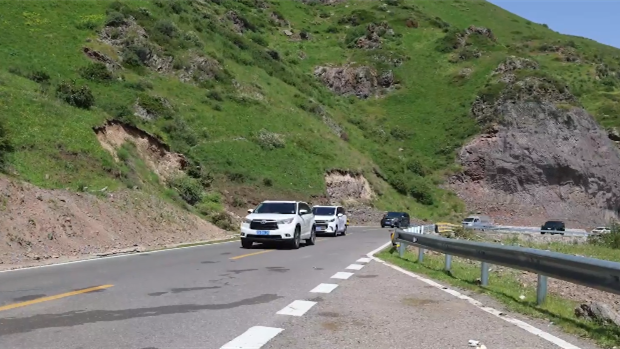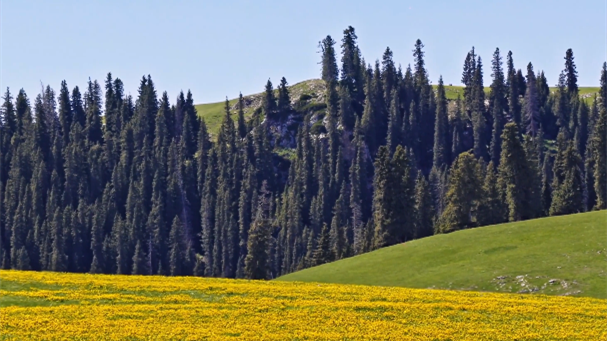



A herdsman herds sheep on Nalati grassland on July 24.
Eminhan Oxur, 70, whose Uyghur name translates as "heroic mother" in English, could also be called the queen of the High Terrace Folk House, which is in the Old Town of Kashi.
She oversees the largest family in the town located in the Xinjiang Uyghur Autonomous Region. And she got an early start in her mothering career.
She got married at 15 and she gave birth to 20 children who produced 36 grandchildren and seven great grandchildren for her. Despite her busy lifestyle, she still makes time for outsiders and relies on them to make a living.
"I am glad to see tourists visiting my place," she told a Global Times reporter. "I tell them stories about my family and show them the beautiful china we make."
The mud-brick walls have supported the High Terrace Folk House for at least 2,000 years and it is one reason it remains a must-see tourist spot in the Old Town of Kashi, also known as Kashgar, meaning "colorful city" in Uyghur.
Huo Bencheng, who is in charge of tourism in the Old Town and works in the Folk House as the manager, told the Global Times that the High Terrace Folk House welcomes about 300 tourists a day, a big jump from the days following the riots a year ago in Urumqi which left about 200 people dead.
"Many residents here rely heavily on tourism. Without tourists, they can't even make a living," he said. Some 4,000 Uyghurs live in the town.
Huo has been working at the Folk House for five years, the only person of Han nationality doing so.
He coordinates tour guides, logs complaints from tourists and even offers advice during family disputes, weddings and funerals.
Shaky grounds
The Folk House was on a list of buildings to be torn down last year due to concerns it might collapse during an earthquake, but that plan changed this year.
The local government intends to reinforce sections of many mud-brick houses using concrete reinforced with iron in keeping with local customs, said Huo.
"Many old people refuse to leave their homes as they have been living here their entire lives," he said.
Despite efforts to preserve the house, Huo is worried Kashi's tourism industry is vulnerable.
"Kashi's tourism industry is even sensitive to small incidents," he said, pointing to a residential building fire in Urumqi on July 19, which left 12 people dead.
That evening, countless people phoned Huo to inquire if it was safe to travel to Kashi.
"I told them it was just an accident, nothing is going to happen in Kashi," he said.
The mood has been similar around many other tourist sites in Xinjiang since last year's deadly riots.
In fact, about 1,450 tour groups comprised of 84,000 travelers, including 4,000 from overseas, canceled their trips to Xinjiang shortly after the riots, the Xinhua News Agency reported.
Also, the number of domestic tourists fell 26 percent to 1.3 million during last year's National Day holiday in October following a string of needle attacks in the capital.

A banner hanging outside Kashi's Old City reads: the only historic cultural city of Xinjiang. Photos: Lin Meilian
Unusual destination
Josh Summers, an American who moved out of Xinjiang earlier this year after four years there, runs a blog called Farwestchina, which he uses to introduce travelers to the region.
"Travelers will have to deal with an increased police and military presence but they shouldn't let that discourage them from enjoying a beautiful trip to Xinjiang," he told the Global Times.
At the same time, many tourists feel that transportation, entertainment and accommodation near many sites need to be upgraded to attract a broader mix of visitors.
In July, Liang Huan and her friend traveled all the way from Guangdong Province to northern Xinjiang to visit Nalati located in the Yili Kazak Autonomous Prefecture, which is home to one of the four largest grasslands in the world. Nearly all guesthouses were packed.
"The view of the grassland is amazing," she said. "But you don't want to stay here for a long time because the things you need to survive for a few months are not available," Liang said.
As she explored the area near the guesthouse, all she saw were roads lined with stalls offering cheap souvenirs and sweet melons, along with loud groups of people.
She paid 260-yuan for a room in the guesthouse and it came without Internet access, an air conditioner, a telephone or even toilet paper, Liang said.
When they packed up and tried to board a bus to the airport, they learned none were available and they had to pay 200 yuan for a car.
"Can anyone explain to me why they built an airport but forgot to arrange airport shuttle?" she said.
Local authorities are improving the infrastructure. A high-end hotel will be completed this month and a 25 million yuan tourist service center will be set up by the end of this year. It will provide information about travel routes and log complaints.
According to the local tourism authority, Nalati received more than 3,000 tourists a day last month, and 55 percent of them came from outside of Xinjiang. On July 17, 5,700 tourists arrived, the highest daily figure since 2008.
Critical year
Chi Chongqing, Party chief of the Xinjiang Tourism Bureau, told the Global Times that social stability remains the biggest issue facing Xinjiang's tourism industry.
"Tourism turns sand into gold and turns cold snow into a hot economy," he said. "But it works only if the society is stable."
This is a critical year for Xinjiang as 19 corresponding provinces and municipalities across China will provide Xinjiang with assistance to encourage development, Chi said.
This move fueled the tourism industry. Xinjiang has received over 100 million domestic and foreign visitors during the first half of this year, up 10 percent over the same period in 2009, according to the bureau.
There are 41 airlines with offices in Xinjiang that offer flights to 30 international destinations and 86 domestic cities, People's Daily Online reported.
"Last year's riot were just a cloud in the sky that blocked the sun for a short time, soon it will be gone and we will see the sun again," Chi said.
Naisierding Yinamu, director of the bureau, unveiled a five-year tourism plan last month and he pledged to raise the annual income from tourism to 70 billion yuan by 2015. |