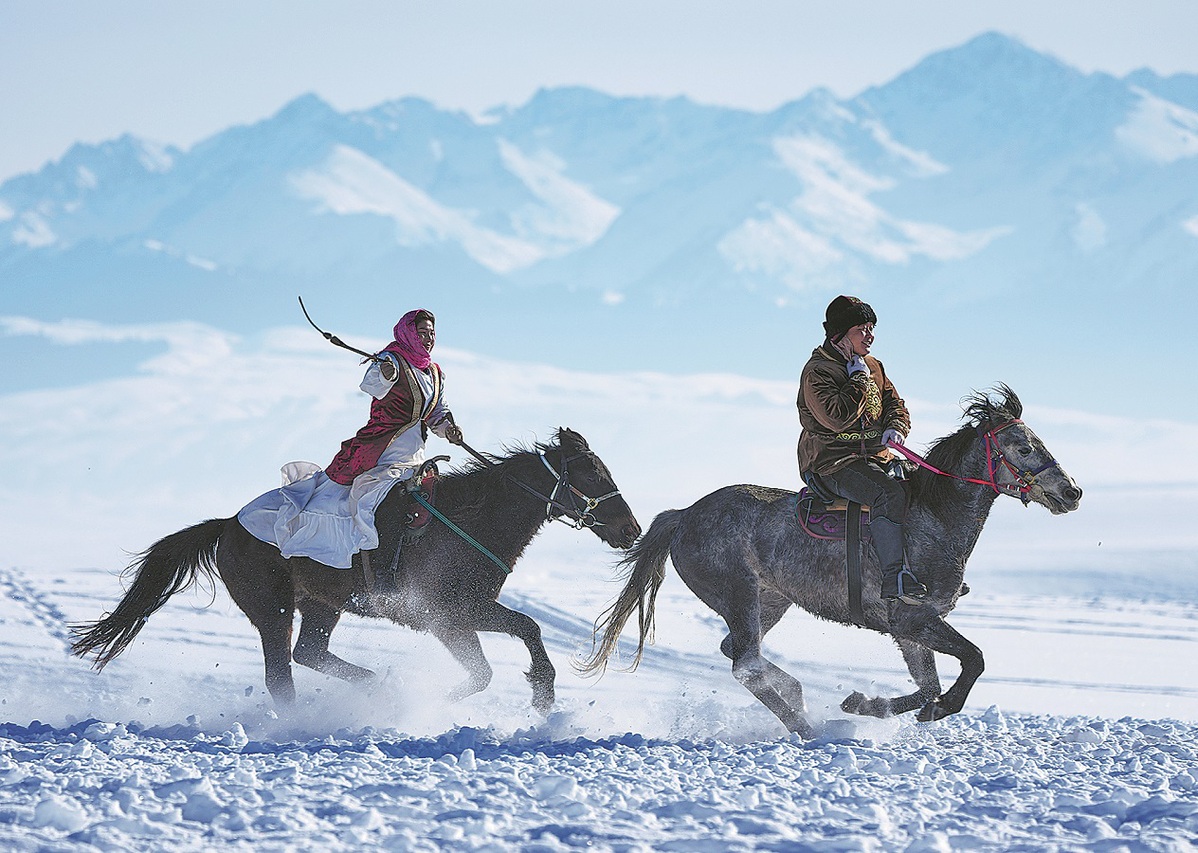
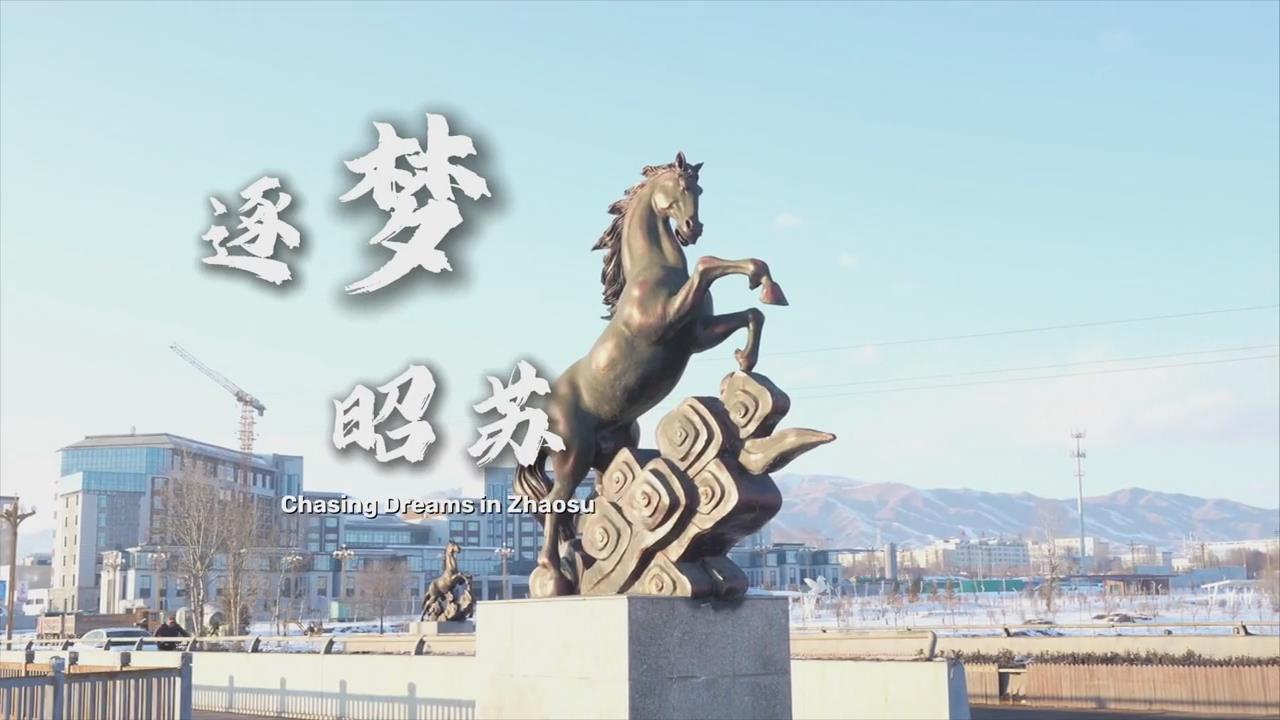
Herders perform horse riding for tourists at Zhaosu Wetland Park in Zhaosu, Xinjiang Uygur autonomous region, on Jan 3. HU HUHU/XINHUA
Snow settles at the foot of the western Tianshan Mountains until a herder lifts his whip and the silence gives way to motion: a line of horses surges forward, hooves striking powder into white mist. In Zhaosu, a remote county in the Ili River Valley in China's far northwestern Xinjiang Uygur autonomous region, winter brings a spectacle locals call "heavenly horses treading snow" — an image that looks ancient, but the economics behind it are not.
For centuries, the Ili River Valley, home to the fabled "Tianma (heavenly horses)" celebrated in Chinese lore, was known for its horses. Positioned along the Grassland Silk Road, it was threaded into successive dynasties' frontier systems through remount stations and courier routes. In that system, horses served as remounts for courier routes and frontier defense, functioning as transport and strategic assets.
The role has largely disappeared, as motorcycles replaced mounted patrols and tractors replaced draught animals. In most places, the loss of practical utility would have led to a steady decline. Zhaosu, however, chose a different response: rather than allowing the horse to fade into heritage, it sought to redefine its economic value.
By the end of 2025, the county counted roughly 122,300 horses, while the Ili Kazak autonomous prefecture as a whole held more than 500,000, about one-seventh of China's total. Yet scale by itself creates no market. The more consequential question is what a region does when a traditional asset no longer serves its original function.
Zhaosu's answer has been diversified. Two state-owned breeding farms anchor a new round of genetic improvement aimed not at plowing or transport, but at leisure riding, competitive sport, and dual-purpose milk-and-meat breeds. A county-wide network standardizes artificial insemination and frozen semen production on a market basis. A performance-testing center, the first in Xinjiang, supports the county's shift toward sport — and leisure-oriented horse breeding.
The language has shifted from "raising horses well" to "operating horses well", a transition that requires institutional scaffolding.
One such institution is Zhaosu's equine hospital. With operating theaters, serology labs, molecular diagnostics, and inpatient wards, it is rare in China's horse sector. Accredited as a specialist training center of equine veterinarians, it cooperates with universities, including China Agricultural University. Where herders once relied largely on experience — palpating a limb, wrapping a joint — owners of valuable racehorses now demand surgery and structured rehabilitation.
Professionalization extends to sport. Since 2021, Zhaosu has hosted more than 420 races and related events, cultivating branded competitions and local talent. Last year, the seven-day Super Derby International Equestrian TREC Endurance on Silk Road drew riders from China, the United States, Italy and Spain, with its longest route stretching 500 kilometers.
"From unified referee uniforms to formal veterinary rescue systems and professional event operations, you can see how much more organized our races have become," said San Kewen, a local female rider who works at the Tianma Tourism and Cultural Park in Zhaosu. The park has expanded from a single racetrack into a broader complex that combines folk performances, equestrian training, and horse-themed camps.
For San, the shift is more personal. She only learned to ride after joining the park, despite growing up in a horse-raising household. What was once a subsistence skill is now service employment.
Tourism also feeds off the spectacle. Rather than relying solely on summer crowds, the county has built a year-round tourism calendar around its horses. Summer brings the well-known "horses bathing in the river", while winter's "horses treading snow" has found a following online, extending visitor traffic beyond the traditional peak season.
In 2025, the county received more than 9.4 million visitors, a notable figure for a place with fewer than 200,000 residents.
Value chains now stretch further. A young local graduate founded a biotechnology firm that refines horse fat and develops soaps, creams and balms. The refined materials are supplied to high-end cosmetics companies and traditional Chinese medicine manufacturers, integrating the county's horse industry into broader national supply chains and external market circulation.
Downstream processing of milk, meat, and fat derivatives adds layers to what was once a single-stage pastoral economy. The county's equine industry accounts for 1.53 billion yuan ($220 million) in output, becoming a pillar industry that supports tens of thousands of farmers and herders. As the horse's traditional roles in transport and military service faded, the county developed new functions in tourism, competitive sport and processing industries.

.png)
.png)
.png)
.png)
.png)

.jpg)
.png)


.jpg)
.png)
.png)
.png)
.png)
.png)