“百闻不如一见”- "Seeing once is better than hearing a hundred times". This ancient Chinese proverb perfectly encapsulates my journey through Xinjiang. As a student from Bangladesh majoring in Chinese literature, textbooks and stories could only offer a glimpse. Stepping into Xinjiang—a crucial hub of the Belt and Road Initiative— was to experience a living, breathing tapestry of culture, history, and breathtaking natural scenery that surpassed all expectation.
.jpg)
A group photo taken during the research and study activity themed "Understanding Contemporary China and Perceiving Open Xinjiang" for international students and scholars from Beijing Normal University at the Intangible Cultural Heritage Inheritance Center of Muqam in Shanshan County, NW China's Xinjiang.
My journey took me through the vibrant streets of Hami, the stark beauty of Yiwu County, the historical depths of Turpan and its Shanshan County, and the modern pulse of Urumqi. Each place offered a new layer of understanding. In Turpan, history felt palpable.
From history, we stepped into nature’s marvels. For someone from Bangladesh—a country of lush rivers and greenery, with no desert—the landscape was awe-inspiring. Seeing the vast, golden sand dunes of the desert for the first time was humbling. And of course, seeing camels—an animal I had only ever seen in pictures—walking across this magnificent scenery was a truly unforgettable moment. It felt as though I had stepped into a different world.
Another world awaited me in Grape Valley—I felt as though I had entered a grape kingdom. Vines formed endless green canopies overhead, with clusters of grapes hanging everywhere. The sweetness of the fruit, savored fresh in the shade of the vines, is a taste I will always remember.
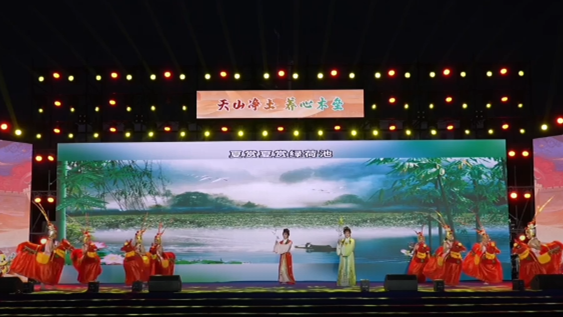
The connections kept coming. One evening, I was privileged to witness a Muqam performance. The haunting melodies and traditional dances were not just a show; they were a time machine. The music gave me a powerful traditional vibe, transporting me back centuries and effortlessly bridging that rich past with the vibrant present. It was a deeply moving artistic experience.
But the true heart of Xinjiang lies in its people. Everywhere we went, from the communities in Hami to the markets in Urumqi, the warmth and hospitality were overwhelming. The people of Xinjiang welcomed me not as a foreign visitor, but as a friend, with such openness that I felt, wonderfully, as if I belonged there. It felt like a second home.
This warmth extended to the dining table. I can confidently say that Xinjiang cuisine has become my absolute favorite in all of China. The fragrant lamb kebabs, the hand-pulled noodles, the flavorful pilaf, and the iconic naan—each dish was a burst of flavor and a testament to a rich culinary culture.
This trip was more than just tourism; it was a dialogue between my homeland and my field of study. Witnessing Xinjiang’s development and strategic significance within the Belt and Road Initiative inspired me to reflect on Bangladesh's own potential and ongoing projects—such as the development of the Chittagong Port. It was inspiring to see a region confidently embracing its future while proudly preserving its unique identity.
In the end, Xinjiang is indeed a window to the world—a place where deserts meet vineyards, where ancient melodies echo in modern air, and where a Bangladeshi student can feel completely at home. It offered me invaluable insights that have deeply enriched my understanding of Chinese culture, history, and literature. I left not just with photographs, but also with a heart full of memories and a deeper connection to this remarkable part of the world.
Soronika Razia Sultana is a Bangladeshi international student studying at Beijing Normal University.
Producer: Xiao Chunfei
Supervisors: Ding Tao and Jie Wenjin
Planners: Jie Wenjin and Cheng Li
Reviewers: Cheng Li and Hou Weili
Editors: Gvlzar Mijit and Fan Feifei
.png)
.png)
.png)
.png)
.png)

.jpg)
.png)


.jpg)
.png)
.png)
.png)
.png)
.png)