Shiliuyun-Xinjiang Daily (Reporter Hei Hongwei) news: From fresh-cut roses to children's toys, daily necessities to new energy vehicles, Chinese goods are reaching Asian and European markets through Xinjiang's ports in growing numbers. Behind this surge, China-Europe freight trains thunder westward day and night. Livestreamers pitch products in Chinese, English and Russian at cross-border e-commerce studios. Cranes hoist cargo and trucks stream nonstop through busy port yards.
According to Urumqi Customs statistics, Xinjiang's total import and export value reached 71.22 billion yuan (about 9.89 billion U.S. dollars) in the first two months of this year, up 36 percent year-on-year, 17.7 percentage points higher than the national average. Behind these impressive figures lie the continuous upgrading of port capacity and customs services, as well as surging market vitality. They also demonstrate the strong momentum of Chinese products going global on the modern Silk Road.
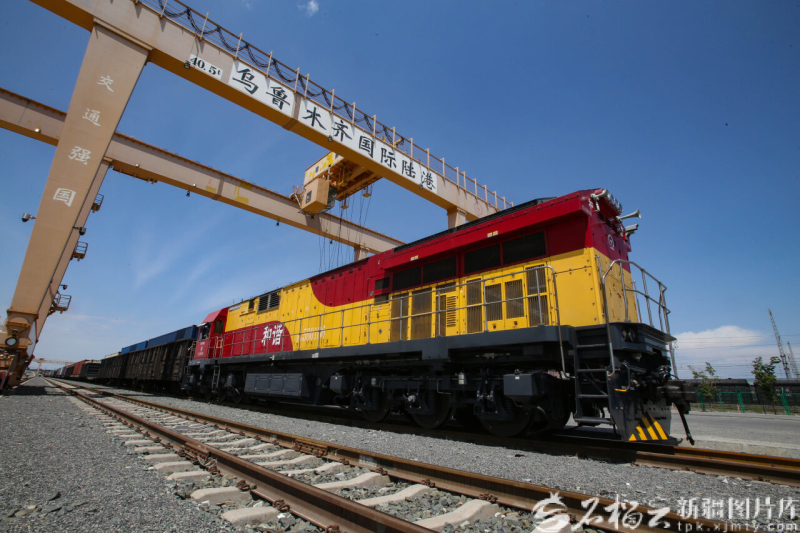
File photo shows a freight train departs from Urumqi International Land Port Area. (Photo by Shiliuyun-Xinjiang Daily/Han Liang)
"Made in China" accelerates onto the global stage
Recently at the Torugart Port, the "steel camel caravan" fully loaded with export vehicles orderly headed toward Bishkek, capital of Kyrgyzstan. From January to February this year, Torugart Customs supervised the export of 7,749 commercial vehicles, up 254 percent year-on-year, a record high for the same period.
In recent years, the five Central Asian countries have gradually entered a "peak period" of infrastructure construction. Demand for various vehicles in mining, large-scale engineering, and logistics transport continues to climb. Chinese new energy vehicles, with their advantages of "good value, complete features, and strong tech appeal," have become the mainstream choice in Central Asian passenger car markets. Relying on the Torugart and Irkeshtam land ports on the China-Kyrgyzstan border, Kyrgyzstan is evolving from a terminal consumer market to a re-export trade hub, becoming a core gateway for "Chinese brands" to enter Central Asia and even broader markets.
The upgrading of product categories has become a clear hallmark of Xinjiang's high-quality foreign trade development. In the first two months, mechanical and electrical products jumped to become Xinjiang's largest export category, with export value up 54 percent year-on-year, accounting for 39.4 percent of total exports. Among them, auto parts, lighting fixtures, electrical equipment, automobiles, and home appliances saw export value increases of 48 percent, 46 percent, 95.7 percent, 22.7 percent, and 30.8 percent respectively. High value-added products are gradually replacing traditional small commodities, reaching Asian and European markets through Xinjiang's ports.
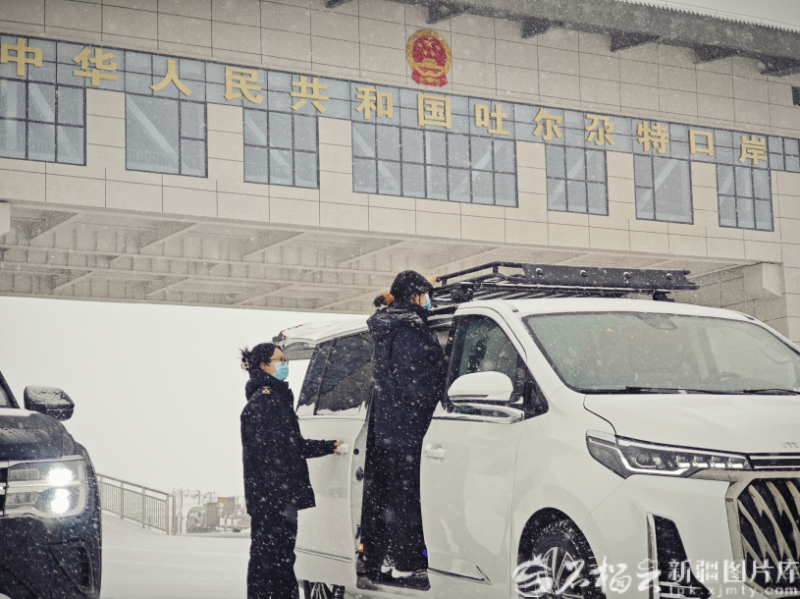
File photo shows frontier customs officers at Turgart Customs conduct on-board inspections on export vehicles.
For frontline businesses, this change is even more tangible. On March 27, 2026, at the centralized inspection yard for exports at the Horgos Road Port, 80 new energy vehicles from Horgos Denuo International Freight Forwarding Co., Ltd. bound for Novosibirsk, Russia, were ready to depart.
Feng Yanhu, general manager of Horgos Denuo International Freight Forwarding Co., Ltd., stated that agency exports of commercial vehicles in the first two months of this year nearly doubled year-on-year, with new energy vehicles accounting for 70 percent and ample orders on hand.
The transformation extends beyond the automotive sector. At the yard of Horgos Feichi International Freight Forwarding Co., Ltd., a spectacular scene unfolds: two cranes extend their long arms like steel giants working in perfect coordination, steadily lifting a 95-meter-long wind turbine blade and precisely placing it onto a flatbed truck dozens of meters long. On one side of the yard, dozens of sets of wind power equipment stand in neat rows.
The advancement of wind power projects in Central Asia has also driven surging demand for equipment. Manager Bekpulat Alibek of Horgos Feichi International Freight Forwarding Co., Ltd. said that eight sets of wind power equipment were exported in the first two months, a substantial year-on-year increase. The port's green customs clearance policy has significantly shortened clearance time, helping high value-added "Made in China" products accelerate onto the global stage through ports in Xinjiang.
Channel economy accelerates transformation into industrial economy
Ports are gateways to openness; industry is the foundation of development.
In recent years, Xinjiang has leveraged its unique geographical advantages to accelerate the transformation from "channel economy" to "industrial economy," shifting from simple cargo transit and flow transfer to building on local specialty industries and cultivating internal growth drivers. This transformation turns port channel advantages into industrial development advantages, allowing quality specialty products to reach broader markets through these channels.
At this season, processing lines for pumpkin seeds and sunflower seeds in Fuhai County and other areas of Altay Prefecture operate at high efficiency, with coordinated loading operations proceeding in an orderly manner. Batches of processed, high-quality specialty seed agricultural products are ready for export through various national ports to overseas markets. With their reliable quality, they continue to expand international sales channels, becoming a vivid microcosm of Xinjiang's industrial economic transformation and development.
The results of industrial development are reflected in impressive data. From January to February this year, Altay Prefecture's cumulative agricultural product exports reached 3,161.4 tons, up 16.2 percent year-on-year. Behind this growth momentum lies the local commitment to specialty agriculture and deep cultivation of agricultural product processing, as well as the direct manifestation of channel advantages transforming into industrial advantages.
"Overseas orders are increasing, and our confidence in expanding international markets is growing stronger," said Zhao Wenhao, head of Xinjiang Shanglihongrun Agricultural Technology Co., Ltd.
Efficient and smooth channels provide crucial support for industrial transformation. "China-Europe (Central Asia) freight trains have clear advantages: faster than sea transport, cheaper than air freight, and with stable schedules, customers highly recognize this," said Chen Long, a business representative at Xinjiang Shunjia International Freight Forwarding Co., Ltd., looking at the busy train assembly scene with satisfaction. Since the beginning of this year, the company has handled over 120 train services, up 15 percent year-on-year, with cargo volume of 210,000 tons, up 23 percent.
The booming development of China-Europe (Central Asia) freight trains has not only opened "fast lanes" for Xinjiang's agricultural products to reach overseas markets but also reduced logistics costs for enterprises and enhanced product market competitiveness, laying a solid channel foundation for industrial transformation. This is just one vivid example of the thriving development of Chinese products shipping out from Xinjiang.
Xinjiang is converting its geographic advantage into economic substance. By developing specialty agriculture and food processing, the region is transforming from a mere transit corridor where cargo passes through into a production hub where value is created and retained.
On March 9, it was warm and bustling inside the Qingquan Flower and Seedling Industrial Park in Qapqal Xibe Autonomous County. Flower farmers were busy sorting and packing gorgeous roses, preparing to send them to Tajikistan through the Horgos Port.
"The industrial park has cumulatively exported over seven million seedlings to many Asian and European countries," introduced Zhang Junzhu, general manager of Horgos Jinghan Ecological Landscaping Co., Ltd. More and more high-quality agricultural products from Xinjiang continue to sell well in Central Asian markets, with steadily improving overseas market recognition.
Smart customs clearance facilitates smooth flow of Chinese products across Asia and Europe
On March 26, 12 trucks fully loaded with cargo completed exit procedures and drove toward Kyrgyzstan through the Bedel Port, marking the port's first temporary clearance of the year.
Luo Shi, deputy section chief of the supervision section at Aksu Customs, introduced that to ensure efficient port clearance, Aksu Customs dispatched personnel in advance for on-site inspections, installed and debugged supervision equipment, closely coordinated with export enterprises to track cargo movements, and optimized the entire process from declaration to approval to inspection. Through front-loaded services and process reengineering, they accelerated customs clearance.
From Alashankou and Horgos to Jeminay and Takixken, ports in Xinjiang are cutting clearance times dramatically through smarter and smoother procedures.
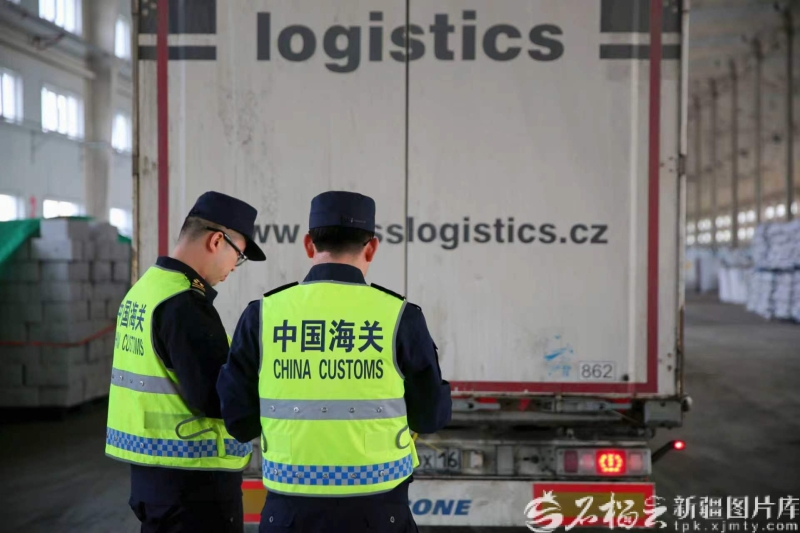
File photo shows customs officers at Alashankou Customs check vehicle information. (Photo by Zhang Dong)
Currently, inbound freight trains at Xinjiang's ports have seen clearance time compressed from the previous two to three days to within 16 hours. Return train reloading takes about two hours on average, and outbound train clearance is compressed to within one hour. Alashankou Port (also known as Alataw Pass) has achieved "second-level release" for inbound trains, with outbound trains completing all procedures in as fast as 20 minutes. Clearance modes have fully shifted from day-based calculation to the second and hour level.
Continuous optimization of customs services relies on the dual support of policy innovation and technology empowerment. In 2020, the General Administration of Customs issued relevant measures to strengthen top-level design. In 2021, the "Railway Fast Clearance" model was implemented, saving about three hours of port dwell time per train. In 2025, Urumqi Customs pioneered the "Smart Railway Port + Rapid Local Clearance" model nationwide, further achieving "second-level release" for trains.
On March 27, the nation's first "multimodal transport + TIR" international transport operation smoothly exited through the Irkeshtam Port, opening a new path for Xinjiang's cross-border logistics. As one of China's westernmost land ports, bordering Kyrgyzstan, Irkeshtam serves as an important node connecting Central Asia, West Asia, and even Europe. And the smooth completion of this first operation validated the port's advantages in connecting different transport modes and efficiently handling TIR clearance procedures.
"Previously, shipping goods to Uzbekistan meant inspections and reloading in Kyrgyzstan. The process was cumbersome," said Wang Longqi, manager at the Kashi branch of Alashankou Aisente International Freight Forwarding. "Now, with the combined 'multimodal transport + TIR' customs supervision model, we complete one declaration, seal the container once, and move it straight to the destination without opening."
The new approach has cut transit times and logistics costs while giving companies like his the confidence to expand deeper into Central Asian markets.
Today, Xinjiang is redefining its border ports from transit points into economic engines. By streamlining customs and building smarter infrastructure, the region is capturing more value from the trade flowing through its gates, turning passing cargo into lasting business.
As efficient and convenient international logistics channels continue to open up, more and more Chinese products are riding the "steel camel caravan" from ports in Xinjiang to the vast markets of Asia and Europe, writing a new chapter of openness and regional coordinated development on the journey of high-quality Belt and Road cooperation.
(A written permission shall be obtained for reprinting, excerpting, copying and mirroring of the contents published on this website. Unauthorized aforementioned act shall be deemed an infringement, of which the actor shall be held accountable under the law.)
.png)
.png)
.png)
.png)
.png)

.jpg)
.png)

.jpg)
.png)
.png)
.png)
.png)
.png)