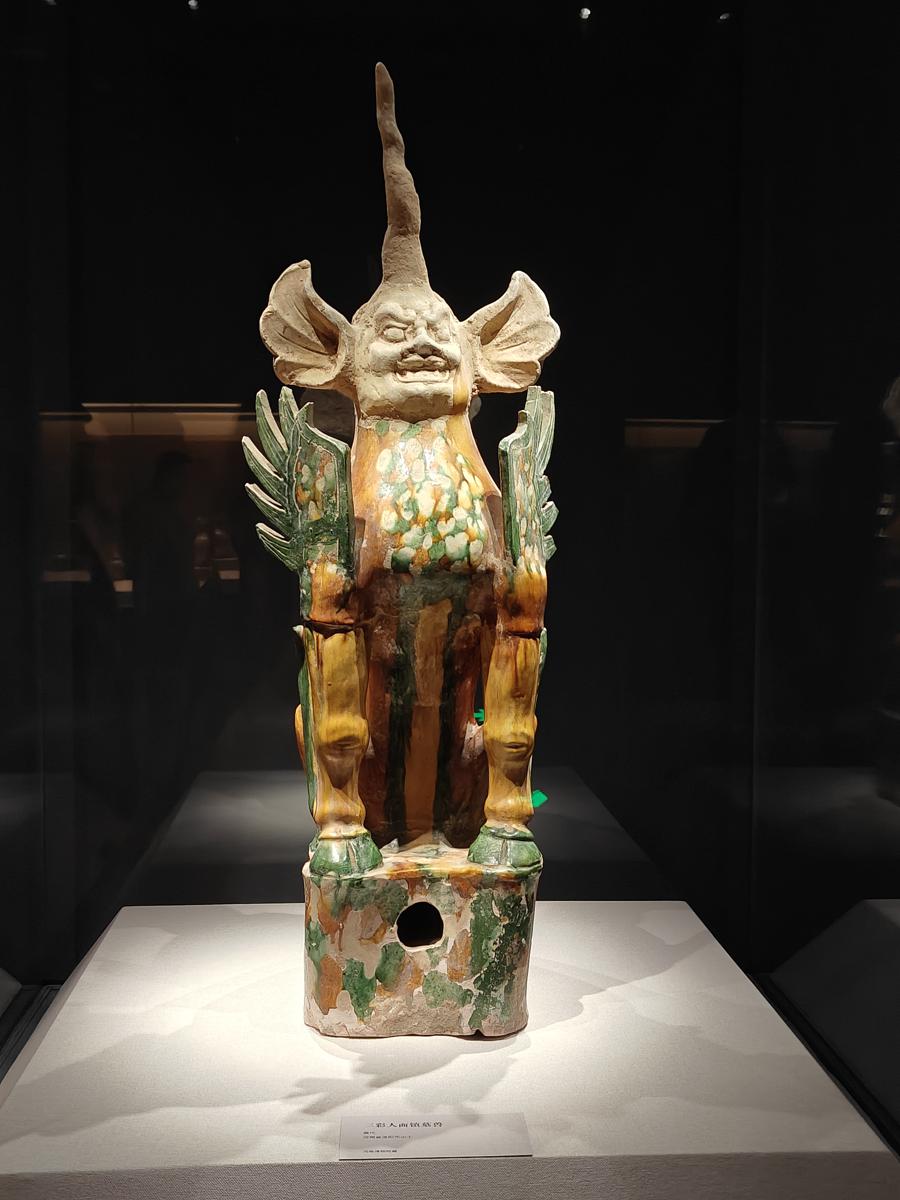
A Tang Dynasty (618-907) sancai (tricolor glazed ceramic) tomb guardian beast with a human face, unearthed in Luoyang, Henan province is on exhibition at Xinjiang Museum in Urumqi through Nov 15. [Photo by Lyu Xingjin/For chinadaily.com.cn]
A collection of artifacts unearthed from Central China's Henan province, dating from the 21st century BC to the 12th century AD, is on display at Xinjiang Museum in Urumqi through Nov 15.
The exhibition of 135 sets of artifacts, curated by Xinjiang and Henan museums, features bronze, jade and ceramic objects from the Central Plains.
.jpeg)
Zhai Hongzhi, deputy director of Henan Museum, introduces several artifacts unearthed from the 3,000-year-old tomb of Fu Hao in Anyang, Henan province. [Photo by Lyu Xingjin/For chinadaily.com.cn]
Highlights include bronze vessels that reflect the early state ritual systems of the Xia Dynasty (c. 21st century-16th century BC), jade pieces and inscribed bronzes that embody the theocratic beliefs and patriarchal-ritual systems of the Shang (c. 16th century-11th century BC) and Zhou (c. 11th century BC-256 BC) dynasties, as well as Warring States Period (475-221 BC) weapons and official seals from the Qin (221-206 BC) to Han (206 BC-AD 220) dynasties that mark the rise of centralized imperial rule.
.jpeg)
A full-scale replica of a Western Han Dynasty (206 BC-AD 24) jade burial suit sewn with gold threads. [Photo by Lyu Xingjin/For chinadaily.com.cn]
Zhai Hongzhi, deputy director of Henan Museum, said that with sections spanning nearly three millennia, the exhibition traces the evolution of Central Plains civilization, reflecting on the region's ritual systems, governance and cultural exchanges, including its long-standing ties with the Xiyu (Western Regions), which encompasses present-day Xinjiang and parts of Central Asia.
.jpeg)
A group of Han Dynasty (206 BC-AD 220) painted pottery figurines. [Photo by Lyu Xingjin/For chinadaily.com.cn]
Adil Abliz, research librarian at Xinjiang Museum, said it was important to bring exhibitions from other parts of China to Xinjiang.
Such exchanges enable local residents to gain a deeper appreciation of the splendid and enduring Chinese culture, while opening up fresh research perspectives and insights for Xinjiang's heritage professionals, he said.
Lyu Xingjin contributed to this story.
.png)
.png)
.png)
.png)
.png)
.jpg)
.png)


.jpg)
.png)
.png)
.png)
.png)
.png)