
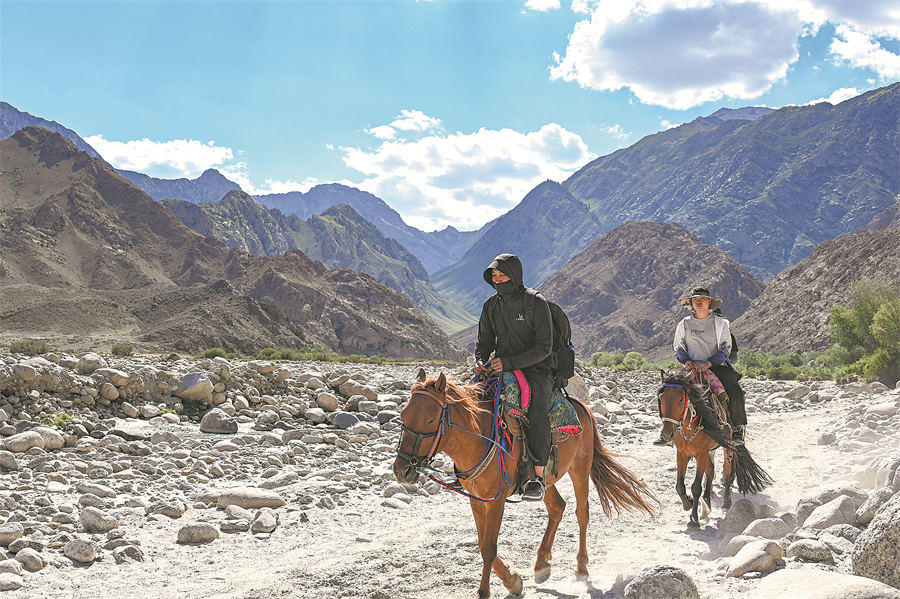
Tourists enter the Wusun Ancient Trail in the Xinjiang Uygur autonomous region on horseback. CHEN SHUO/XINHUA
Tour guide Ars, dressed in a checked shirt, felt hat and a pair of sneakers, sat in the saddle among fellow riders waiting in line one recent morning; his horse stopped occasionally to nibble on nearby leaves and grass as the line moved along. He did not appear too bothered by the delay.
"We're short of horses when tourist numbers peak," he said, laughing.
This is a familiar scene deep in the Tianshan Mountains, in a Kazak village called Qiongkushitai, where gridlock is not caused by cars but horses, as a growing number of tourists line up to ride into the mountains.
Guiding tourists on horseback along the northern stretch of the Wusun Ancient Trail, a historical route connecting the northern and southern sides of the Tianshan Mountains, used for centuries by traders and herders, is now Ars' job. It wasn't really his plan.
Growing up in the area, Ars played in the spruce forest along the river valley and grazed his family's herd there. "Back then, the forest was just a forest, and the stream was just a stream," he said. Today, he said, both draw tourists eager to photograph them.
Qiongkushitai — which means "great platform" in Kazak — is located in the mountains in Tekes county, Northwest China's Xinjiang Uygur autonomous region. For generations, it was a waypoint for herders moving between seasonal pastures, and the northern gateway to the Wusun Ancient Trail. Today it draws hikers, photographers and tourists from around the country.
The village's growing popularity has come amid a broader surge of interest in travel to Xinjiang in recent years. Demand to visit the region's grasslands, mountains and pastoral landscapes received an additional boost after the popularity of To the Wonder, a 2024 TV drama adapted from writer Li Juan's essay collection My Altay. The drama drew widespread attention to northern Xinjiang's scenery and slower-paced way of life. There's no admission fee and no wall around the village. Visitors encounter not only forest, pasture and streams but also the daily life of the herding families who still live there, some of them in log cabins built from spruce and pine, joined without nails. Some have stood for nearly a century.
In recent years, some residents have begun folding traditional skills such as baking naan bread, felting wool, and making dairy products into the visitor experience, giving tourists a closer look at herding life rather than just its scenery. Local tourism officials in Tekes said the village had received close to 600,000 visitors this year as of early August.
Ars' family has herded livestock on a few hundred hectares of contracted pastureland for generations. But when it came time for him to choose a path, he went to college first, enrolling at Shihezi University in 2019 — the same year Qiongkushitai, already designated a Chinese historical and cultural village, was named among the country's first batch of key rural tourism villages.
After graduating, he chose not to stay in the city. Instead, he returned home, becoming one of more than 20 college graduates who came back to the village in recent years to work or start businesses, according to local officials.
With his family, he renovated eight aging houses and began renting them to a tourism company to run as homestays. This decision now brings in more than 100,000 yuan ($15,000) a year, according to Ars.
Village officials said Qiongkushitai now has 167 registered homestays, up from a handful of rooms once offered informally to hikers passing through. What began as a bed and a meal has, in many cases, grown into an immersion in local customs, they said.
The village's horses have also found new value.
After local cooperatives were formed to coordinate bookings, Ars' family began entrusting its horses to one of them, earning a share of the proceeds based on how often they are hired out. According to Li Sheng, a local official involved in tourism development, two such cooperatives now manage 523 horses. Together, he said, they generated 4.5 million yuan in tourism revenue last year and are on track to exceed 5 million yuan this year.
Ars and a growing number of young people have returned to the village and are now creating new opportunities.
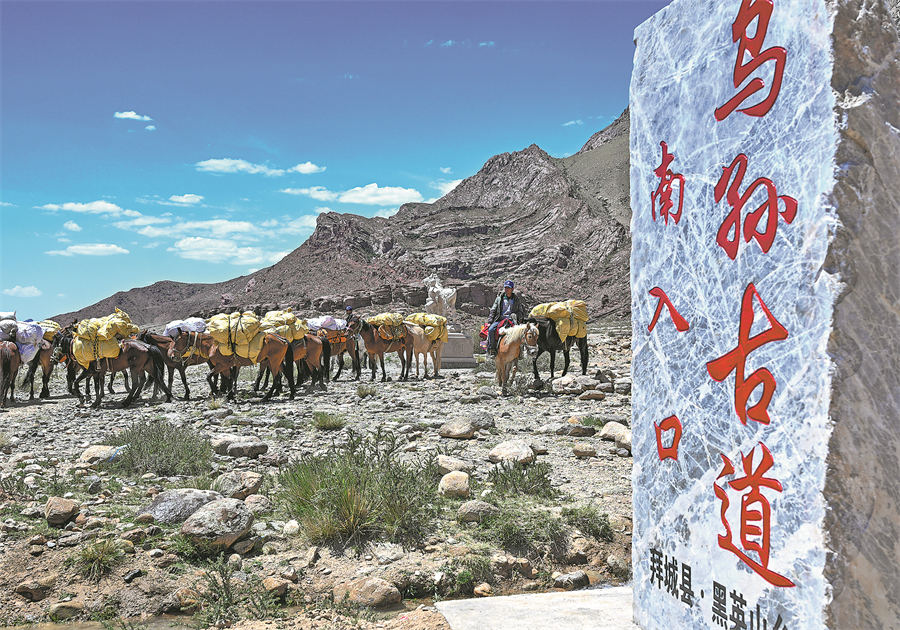
Horses packed with hikers' luggage prepare to enter the trail. CHEN SHUO/XINHUA
Some have opened homestays. Others run coffee shops, camping sites, or businesses built around Kazak cultural traditions. They know the horses and the spruce forest, but they have also seen life beyond the mountains. Some residents say they have brought new ways of thinking about the local economy back with them.
Even so, the season is short. Road conditions and the mountain climate limit the tourist season to roughly five months. By mid-October, the weather turns colder and visitors thin out.
Ars, like many in the village, will head back to the county seat for the winter, where he has already bought an apartment. He plans to marry his girlfriend, who works there, next spring.
Winters in northern Xinjiang are long, and snow settles over the forest and the old trail.
When the grass turns green again, Ars said that he expects to be back in the saddle, riding once more through the forest he grew up in — ready for another crowded summer.










.png)
.png)
.png)
.png)
.png)

.jpg)
.png)