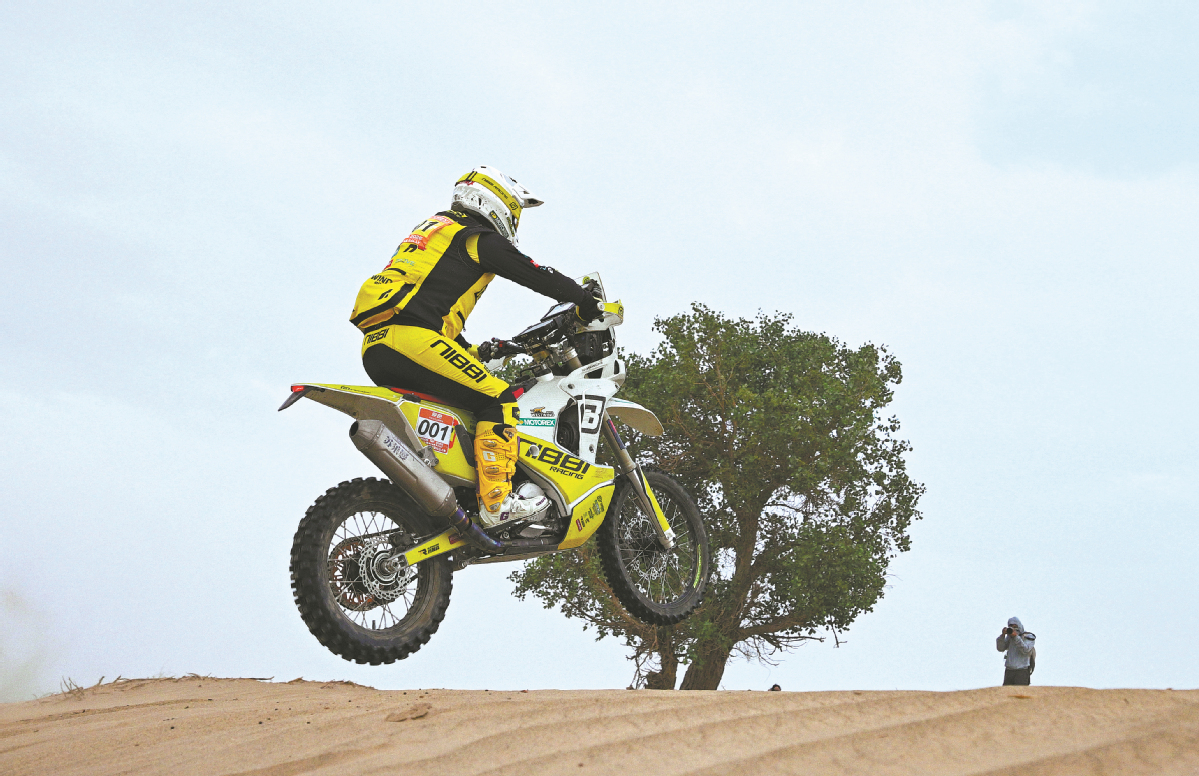
Sulaiman Daguti, riding for Nibbi Racing, takes on the tough, sandy terrain of the Xinjiang Uygur autonomous region during last month's Taklimakan Rally. [Photo/Xinhua]
Nicolas Cavigliasso has spent much of his life chasing different horizons.
The Argentine rally champion has crossed Saudi dunes in the Dakar Rally, endured punishing deserts on multiple continents and stood atop podiums after some of motor sport's hardest races. But in China's far west, under the endless skies of Xinjiang Uygur autonomous region, even he found something unfamiliar.
He and his navigator wife, Valentina Pertegarini, arrived at the Taklimakan Rally in a Chinese-made hybrid SUV, carrying with them equal parts curiosity and uncertainty.
"This is our first time at this Chinese race, and the car is completely different, too," Cavigliasso said. "It feels like a different kind of adventure."
For 17 days and 7,500 kilometers, cars traverse through some of the harshest terrain in Asia. But beyond the race itself, the event is increasingly serving as a meeting point — between China and the world, between technology and tradition and between isolated desert towns and the global spotlight.
Great Wall in the desert
China's new-energy vehicle industry has expanded at staggering speed. In 2025, the country produced more than 16 million new-energy vehicles, with such cars accounting for over half of all new vehicle sales nationwide.
Now, Chinese automakers are steering those ambitions away from city streets and, quite literally, off the beaten track.
Last year, the Taklimakan Rally introduced a dedicated "new-energy" category, transforming the desert into a testing ground for battery systems, hybrid engines and endurance technology, with Chinese automaker Great Wall Motor inviting international racers to push its off-road vehicles to their limits.
Cavigliasso accepted immediately.
"In racing, the harsher the environment, the more valuable the experience," said Liu Yanzhao, a vice-president at Great Wall Motor. "International drivers bring another perspective. Their understanding of performance and reliability helps Chinese manufacturers improve much faster."
Inside their Tank 700 hybrid SUV, the husband and wife move almost as one, with Pertegarini reading road books and navigation points, while Cavigliasso studies the terrain ahead.
"We are exploring this place together," he said. "We want good results, but we also want to help discover the potential of this car."
The learning curve was steep.
Hybrid systems require a different rhythm in the desert. Drivers must think not only about speed and fuel, but also about battery output, energy recovery and how to preserve power while climbing towering sand dunes.
Yet, only days into the race, the Argentine couple captured victory in the SS2 stage.
"Some places here feel like Dakar," Cavigliasso said. "But this car keeps going through everything."
Italian driver Rebecca Busi, another member of the Great Wall team, said some dunes in Xinjiang were even tougher than those she had encountered in Chile.
"The sand here is very soft," she said. "The car struggles more. But the power is strong."
"For them, the development of Chinese car brands happened faster than expected," Liu said.
Far-flung town awakens
Long before sunrise in Qiemo county, Rozi Memet was already awake.
At 5 am, while the desert air still carried traces of cold, the 60-year-old and his son began preparing roasted lamb for rally visitors arriving from around the world.
By noon, the free government-provided stall inside the rally camp was surrounded. Mechanics in dusty uniforms, foreign racers and local families crowded around sizzling meat and stacks of naan bread.
In a single day, Rozi sold the meat of 10 sheep. Yet profit, he insisted, was not what mattered most.
"I'm happy because so many people came to my hometown," he said. "Even foreigners. I've never seen this before." Qiemo sits on the southern rim of the Taklimakan Desert. Covering nearly 140,000 square kilometers, an area larger than Greece, but the county remains one of China's most remote places.
Most of the land is empty desert. Towns lie hundreds of kilometers apart. Many of the county's 80,000 residents may spend years without ever seeing a major sporting event.
Then the rally arrives.
Race vehicles roll into town like a traveling caravan. Music echoes across the camps. Children climb fences to glimpse giant machines coated in sand.
"It feels even livelier than New Year," said Liu Yan, a local tourism official."Thousands of people came to dance, sing and eat together with the racers."
For local officials, the event is also an opportunity to showcase a region long hidden by geography.
Qiemo is known for jade and red dates, but reaching outside markets has always been difficult due to its limited visibility and lack of wider recognition.
"The rally gave us a rare chance," Liu said. "Suddenly people from many countries are seeing our hometown."
Busi posted videos online showing local residents greeting drivers with traditional dances and trays filled with naan, dried fruit and fresh grapes.
For many locals, the cultural exchange felt just as important as the race itself.
"We are the hosts," Rozi said. "When guests come, we should welcome them well."
Going global
Out on the course, every vehicle races alone against the desert. But beyond the dunes, the Taklimakan Rally is drawing increasing international attention.
At this year's opening ceremony, Adrien Le Pan de Ligny, an international affairs official for the Dakar Rally, watched Chinese race teams line up beneath fluttering flags as he explored new partnerships and opportunities with local manufacturers and drivers.
"There is huge potential here," he said."The terrain is diverse, the competition is strong and more international drivers are joining every year."
In 2024, the Taklimakan Rally officially joined the International Automobile Federation (FIA) calendar, a milestone that pushed the event further into the global motor sports spotlight.
For Adrien, cooperation between Dakar and the Taklimakan Rally feels inevitable.
"We can learn from each other," he said. "The Taklimakan Rally can become even more international."
That transformation is already visible.
This year, the rally attracted a record 152 race vehicles, including 28 international racers from eight countries, such as Argentina, Italy, and Spain, as well as competition trucks from Russia's Kamaz Master and Ural Motorsport.
Russian convoys entered China through Khorgos Port, one of the busiest gateways along China's modern Silk Road trade route.
"We had competed in China before, on the Silk Way Rally, but this is our first Taklimakan Rally," said Ekaterina Doronina, marketing manager of Kamaz Master. "The desert here is beautiful and extremely challenging. It pushes the entire team to become stronger."
Kamaz Master has won the Dakar truck category 19 times. Yet even this legendary team now sees China's western deserts as part of its future.
"Maybe next year we will bring even more trucks," Doronina said.
As the sun falls behind the dunes, rally vehicles disappear one by one over the desert horizon, leaving only dust hanging in the evening light.
For a few weeks each year, however, this remote edge of western China no longer feels distant.
The world comes to Xinjiang instead.
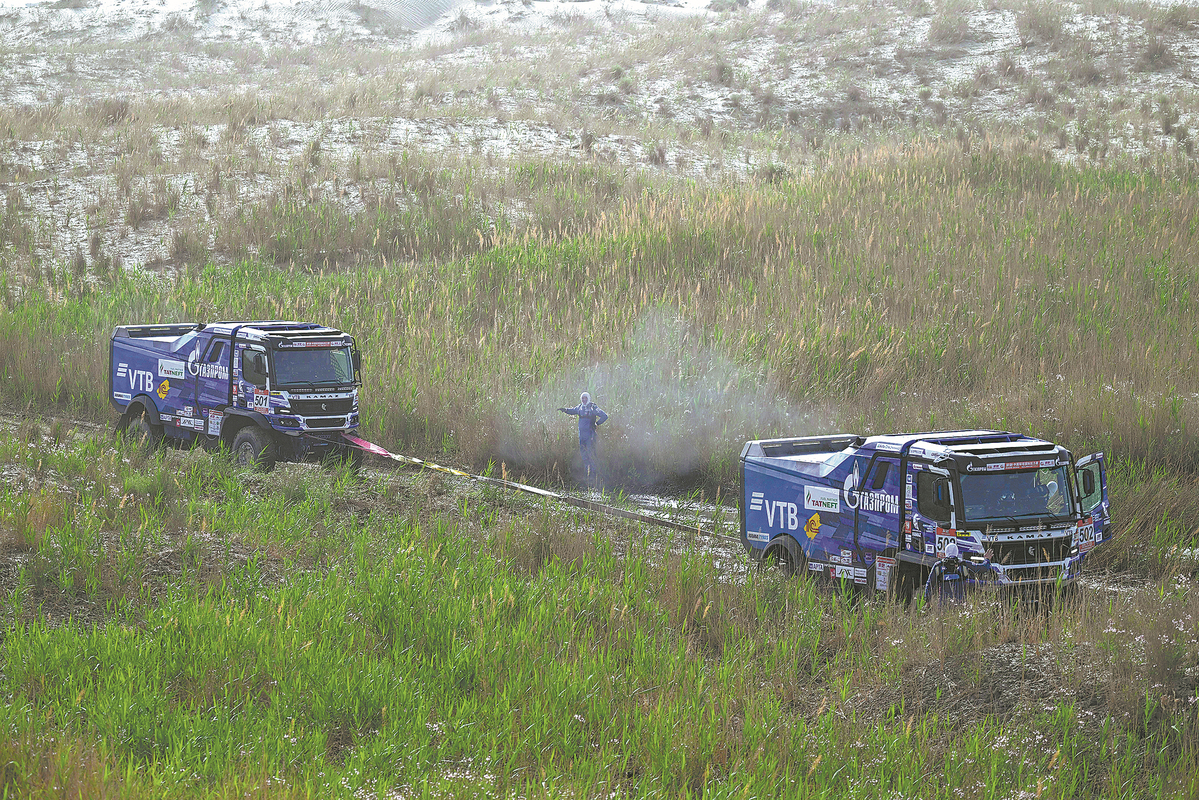
Trucks from Russian team Kamaz Master pull their way out of trouble on the Taklimakan Rally last month. [Photo/Xinhua]
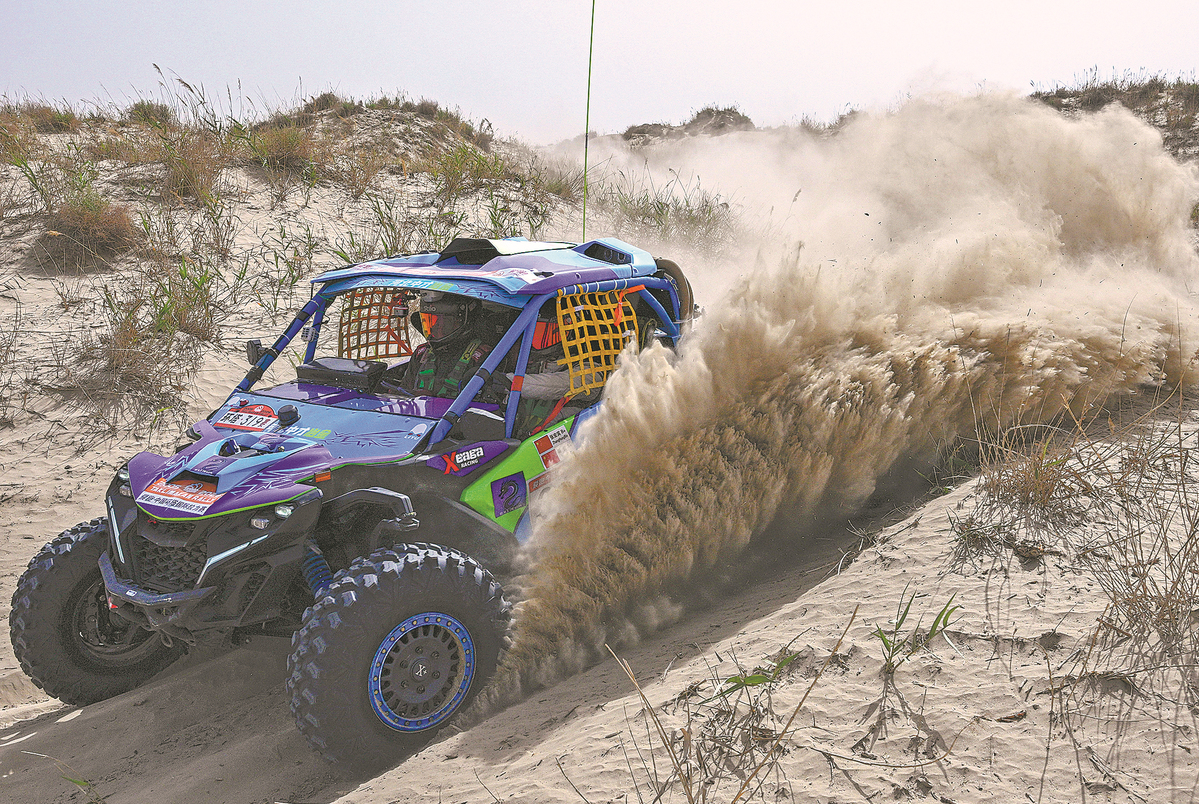
Chinese driver Hu Jian and navigator Zhang Hongbin of Hebei Zhongcai Racing Team in action. [Photo/Xinhua]
.png)
.png)
.png)
.png)
.png)

.jpg)
.png)
.jpg)
.png)
.png)
.png)
.png)
.png)