.png)
Officials and villagers gather to discuss local matters and legislative items in Hudiyayuz, a town in the Ili Kazak autonomous prefecture in Xinjiang Uygur autonomous region, on April 28. CHINA DAILY
Under the lush canopy of a mulberry tree in a village in the Xinjiang Uygur autonomous region, over 20 villagers from various ethnic backgrounds — including Uygur, Kazak, and Han — gathered this month to chat about local matters over milk tea and nang bread.
Leading the discussion was Zhao Jianquan, the village head, who was introducing the newly adopted Ethnic Unity and Progress Promotion Law, which will take effect on July 1.
Zhao recalled how, during a review of the draft law the previous year, villagers had proposed expanding volunteer teams to look after left-behind children, take the elderly to see doctors, and maintain public sanitation. They believed these activities could enhance interaction and mutual support among different ethnic groups in their village.
To their surprise, this simple suggestion from Hudiyayuz, a remote area in the Ili Kazak autonomous prefecture, swiftly reached China's top legislative body through an "express line" and was finally incorporated into the law.
.png)
Officials listen to suggestions at a hospital in Kuqa, Aksu prefecture, on April 30. CHINA DAILY
In March, the National People's Congress passed the law, which encourages and supports volunteers and volunteer service organizations in fostering exchanges, cooperation, and mutual assistance among all ethnic groups.
"Our suggestion was adopted nationally and became part of the law. We're proud of this achievement," Zhao said.
The "express line" that carried their suggestion is a legislative outreach office established by the NPC Standing Committee's Legislative Affairs Commission in Hudiyayuz township in July 2022. It is Xinjiang's first national-level outreach office.
.png)
Legislative information collectors consult with residents at a villager's home in Isihara town in Kuqa on Feb 6. CHINA DAILY
Grassroots voices
The legislative outreach office is an initiative launched by the commission in July 2015. It acts as a bridge between the public and lawmakers to effectively solicit a wide range of opinions and suggestions on legislation from all walks of life, putting whole-process people's democracy into practice.
To date, the commission has established 60 such offices across the country, with 16 located in border ethnic regions. Between July 2015 and April 2026, over 77,000 opinions were collected on 224 legislative documents, with nearly 11,000 of those coming from border areas.
Following the establishment of the office in Hudiyayuz, the standing committee of the people's congress in Kuqa, Aksu prefecture, became the second location in Xinjiang to open such an office. Both have played a big role in seeking legislative ideas from the public.
In 2024, Fan Linsong, a 30-year veteran of the energy industry from Xinjiang Kuqa Green Hydrogen Co, saw his suggestion regarding hydrogen energy incorporated into the Energy Law.
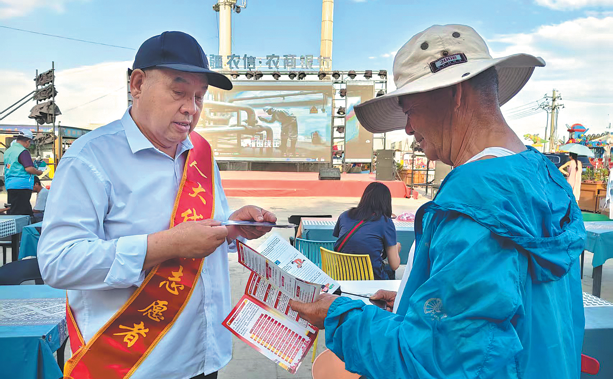
A deputy to Kuqa's municipal people's congress collects suggestions from a tourist for improving the city's historical area on April 23. CHINA DAILY
After the project began operating in Kuqa in 2023, he realized the significant role hydrogen could play in energy security and low-carbon development. Noticing its absence in the draft law, he suggested that legislators boost the hydrogen industry and increase support for hydrogen technology research.
When the Energy Law took effect in January 2025, he found his advice had been included in provisions encouraging the development, utilization, research and storage of hydrogen-related technology and equipment.
"This was a huge encouragement for me and my team," he said, adding that he plans to continue sharing new ideas through the office to ensure that policies and laws better support industrial development.
The national-level outreach office model is being replicated in local legislation as well. The standing committee of the Xinjiang people's congress has expanded the initiative by establishing similar offices in subdistricts, industrial zones, and communities. This expansion has helped gather input from a broader range of people during the formulation and revision of local regulations.
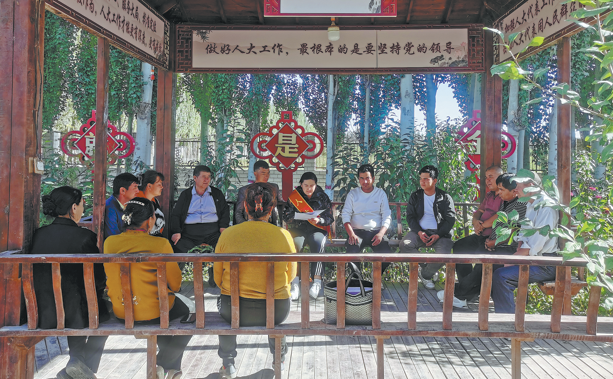
Deputies to Kuqa's municipal people's congress consult with residents about their opinions on the draft amendment to the Law on Standard Spoken and Written Chinese Language in September at a village in Kuqa. CHINA DAILY
Kuqa resident Zulpikar Amar submitted a suggestion through the local outreach office while attending a community seminar in late 2025. He called for streamlining the approval process for housing maintenance funds needed for emergency repairs for burst pipes, elevator breakdowns, and fire equipment damage. He said such procedures were often delayed due to unclear timelines, which frustrated property managers.
"I was just highlighting work problems during the meeting never expecting it would lead to change," he said. "I was pleasantly surprised when the revised regulation in May incorporated my suggestion, clearly listing emergency situations and setting defined review timelines."
Under the amended local regulation, maintenance fund officials are required to review applications within two working days and release funds promptly if conditions are met.
"I never imagined that someone like me could have my voice heard by lawmakers, let alone see my first suggestion included in a regulation," he added. "It's reassuring to see democracy in action where I live."

Officials visit a local dried fruits and nuts store to collect opinions in Kuqa on May 8. CHINA DAILY
Unifying legislation
Ye Jianxun, deputy head of the legislative affairs commission of the standing committee of Xinjiang people's congress, said outreach offices in border ethnic regions are instrumental in fostering a strong sense of community.
Adil Rehmet, an official from Qiman township in Kuqa, said information collection stations have been established in many villages to teach residents how to provide suggestions through the Kuqa outreach office, and improve officials' understanding of grassroots concerns.
In Baiyang village, for example, efforts to make legislative participation more accessible include posting draft laws in plain language and organizing discussions on legal issues relevant to villagers, such as land transfers, and marriage and family matters. In addition, QR codes and phone numbers of officials are made public to enable villagers to report urgent problems at any time.
"These measures break down barriers, making it easier for people — especially those from minority ethnic groups who are not proficient in Putonghua, or standard spoken and written Chinese, to provide suggestions, thereby protecting their right to be informed about the law and to express their views," Adil said.
This process unites all ethnic groups and strengthens the "community spirit of the Chinese nation", he added. "As an ethnic minority official who was raised here, I believe ethnic unity is key to ensuring long-term stability and prosperity," Adil said.
Zamira Hopurjan, an outreach officer from a multi-ethnic tourism village in Ili, led left-behind women in establishing a tea factory after discovering their eagerness to start businesses. Now, 44 women work at the factory, learning new skills and earning an income.
"Outreach offices provide a platform for me to better understand local people's needs and fulfill their aspirations for a better life," Zamira said. The Ethnic Unity and Progress Promotion Law will encourage local governments to take employment and entrepreneurship measures to promote ethnic integration, she said.
"Our experience has been workable. I believe more people will contribute to strengthening ethnic unity, and their lawful rights will be better protected," she added.
Mirigul Memet, a judge from Shuimogou District People's Court in Urumqi, the capital of Xinjiang, has integrated legislative consultation with legal education in her work.
To help implement the Law on Standard Spoken and Written Chinese Language, she conducted community and school lectures using real-life cases to explain how standard Chinese enhances exchanges, job opportunities, and shared development. She also patiently listened to people's expectations regarding language, culture, public services, and rights protection that were relayed through an outreach office.
In her courtroom, she upholds the principle of equal protection for all ethnic groups, and focuses on strengthening ethnic unity while handling disputes.
Last year, when reviewing the draft law on ethnic unity and progress promotion, she suggested schools integrate fostering "a sense of community for the Chinese nation" into classroom teaching and social practices, which was ultimately incorporated into the final version of the law.
"Teenage years are critical for shaping values and national identity. It's essential that fostering a sense of community starts from childhood," she stressed. "Schools should introduce the ethnic unity law in ways that children can easily understand, thereby helping to enhance their legal awareness."
She highlighted the significant role of the rule of law, adding, "I will continue to be a guardian of the rule of law for ethnic unity."
Spreading awareness
While encouraging people to participate in legislation through outreach offices across the autonomous region, Xinjiang has also stepped up efforts to use these sites to provide legal education.
At a night school for farmers and herders in a Kuqa village, training sessions are held every Monday, Tuesday and Thursday. Village head Gulpiya Turdi said the classes are determined on standard Chinese proficiency. Each two-hour class includes one hour of Putonghua learning, and one hour of legal education.
She said most villagers are from ethnic minorities, with some participants older and others less educated.
"Combining language learning with legal cultivation fits their needs and makes laws more relatable," Gulpiya said. "Only when they understand what the law means can they offer targeted suggestions, leading to better law-based governance."
Ma Ziyang, head of Guangming community in Kuqa, agrees with this approach.
"Law is not just text — it is a pillar that solves problems. Only when legislation directly addresses people's real needs can it be effectively implemented," he said.
Ma, a former police officer, uses real-life scenarios — such as flight delays, school bullying, and self-defense — to explain legislation such as the Civil Aviation Law and the Public Security Administration Punishment Law to residents.
He also conveys the public's concerns through the Kuqa outreach office, contributing to legislative changes. This establishes a positive cycle of effective legal education and responsive lawmaking.
In Horgos, a city at the forefront of China's westward opening-up, collecting input on legislation is also progressing in an orderly manner, supporting both grassroots governance and opening-up.
The standing committee of the city's people's congress brought together 84 people — including law enforcement officials, legal professionals, residents and business representatives — to form a legislative input collection team. The team also integrated legislative consultation with foreign-related legal services.
Zhu Xuejie, a lawyer from Horgos, said she and other collectors concentrated on common legal issues related to contracts, labor and foreign trade. This helped introduce laws to people, with legal services also provided for enterprises aiming to go global.
"Our efforts are focused on promoting Xinjiang's high-level opening-up and improving grassroots governance of foreign-related disputes by strengthening the prevention and resolution of conflicts at their source," Zhu said.
Ye, the deputy head of the legislative affairs commission, said that outreach offices and information collection stations in Xinjiang serve not only to widely gather public opinions, but also to enhance legal awareness among the populace. "Only when legislators and ordinary people move toward each other can we better protect people's rights and ensure that law-based governance takes root at the grassroots level," he said.

.png)
.png)
.png)
.png)
.png)

.jpg)
.png)


.jpg)
.png)
.png)
.png)
.png)
.png)